
Security Engineer Kaun?
Security engineering is not just hacking, scanners, or tools. It is people, context, systems, automation, and reducing risk without slowing everyone down.

Hero image inspired by Sapne Vs Everyone. Strong show.
If your security program only produces tickets, congratulations — you have built a very expensive notification system.
That is not the same thing as security engineering. Finding bugs is useful, but finding bugs is the easy part.
The harder question is what happens after the bug is found: who understands the risk, who changes the system, and who makes sure the same class of failure does not come back next quarter wearing a different hoodie?
Everyone has a version of this person in their head.
hoodie hacker Burp Suite wizard bug finder person who says no CVE-ticket forwarder
Cinematic. Also incomplete.
A security engineer is prompt, present, thinks unconventionally, and asks the uncomfortable questions when nobody else is asking them.
They understand:
- how systems fail
- how people build under pressure
- where the business is exposed
- which questions reveal hidden risk
- how to reduce risk without turning the company into an approval machine
Security engineering is engineering under adversarial conditions.
Attackers only need to be right once. Defenders are expected to be right every time.
That asymmetry is why the work cannot stop at finding bugs. It has to become systems, defaults, and habits.
It is also people work, context work, automation work, and finally, risk work.
tl;dr
Security engineering is not just hacking, scanners, tools, or Jira tickets.
It is about:
Understand what can hurt the business, then make that risk smaller.
Judge risk by reachability, data, ownership, impact, and business reality.
Notice the assumptions and failure modes everyone else skipped.
Developers, managers, platform teams, and leadership need different answers.
Use tools and automation as leverage, not as the whole job.
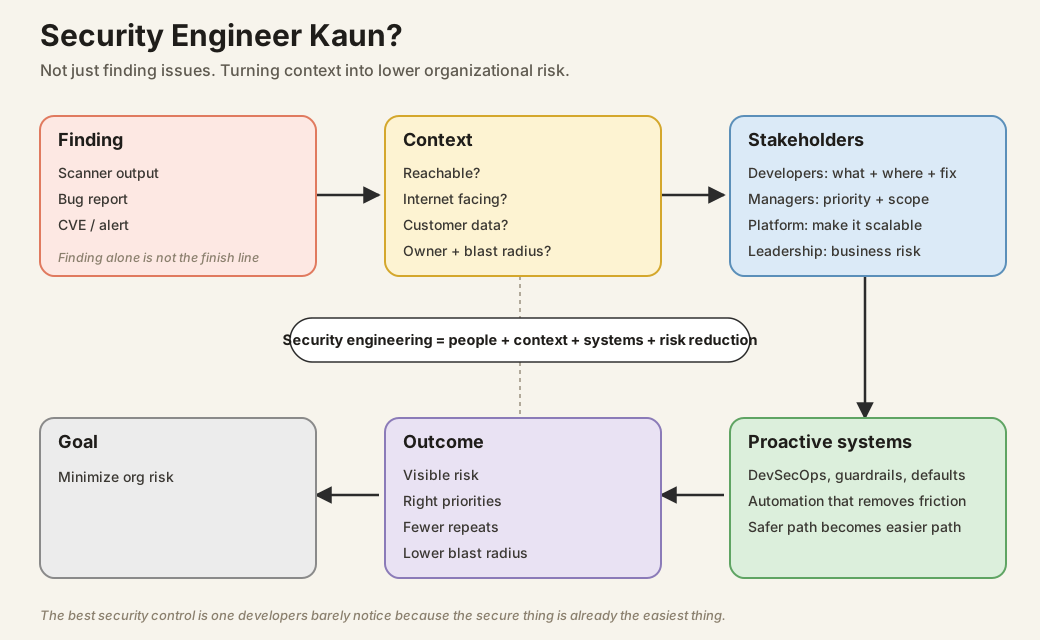
Think of the headings below as the operating principles behind the role. They are not a checklist for running one scanner or one review. They are the mental model I would want a new security engineer, an engineering manager, or a CISO to share: findings need context, context needs people, people need usable paths, and all of it should reduce risk instead of merely creating motion.
Backlog generation is not security engineering
A scanner can find a vulnerable package. A SAST tool can flag a pattern. A bug bounty report can point to an endpoint. A SOC alert can say something suspicious happened at 2 AM.
None of that is useless. But none of it is automatically security engineering either.
A finding becomes useful only when someone turns it into context:
- In product security, does this flow expose customer data or bypass authorization?
- In infrastructure security, is this role, bucket, cluster, or network path actually exposed?
- In DevSecOps, can this be caught before merge or deploy next time?
- In the SOC, is this alert malicious, expected behavior, or a detection gap?
- In platform engineering, is this one service or a repeated pattern across teams?
The finding is the alert. The work is figuring out what it means, what it risks, and what should change because of it.
A dependency scanner lights up red: critical RCE in a library you ship. The backlog says “fix now.”
The security engineering part is the ten minutes spent realizing the vulnerable function is only reachable from a build-time script that never touches user input. The same CVE drops from “drop everything” to “bump it next sprint.” The work was the context, not the ticket.
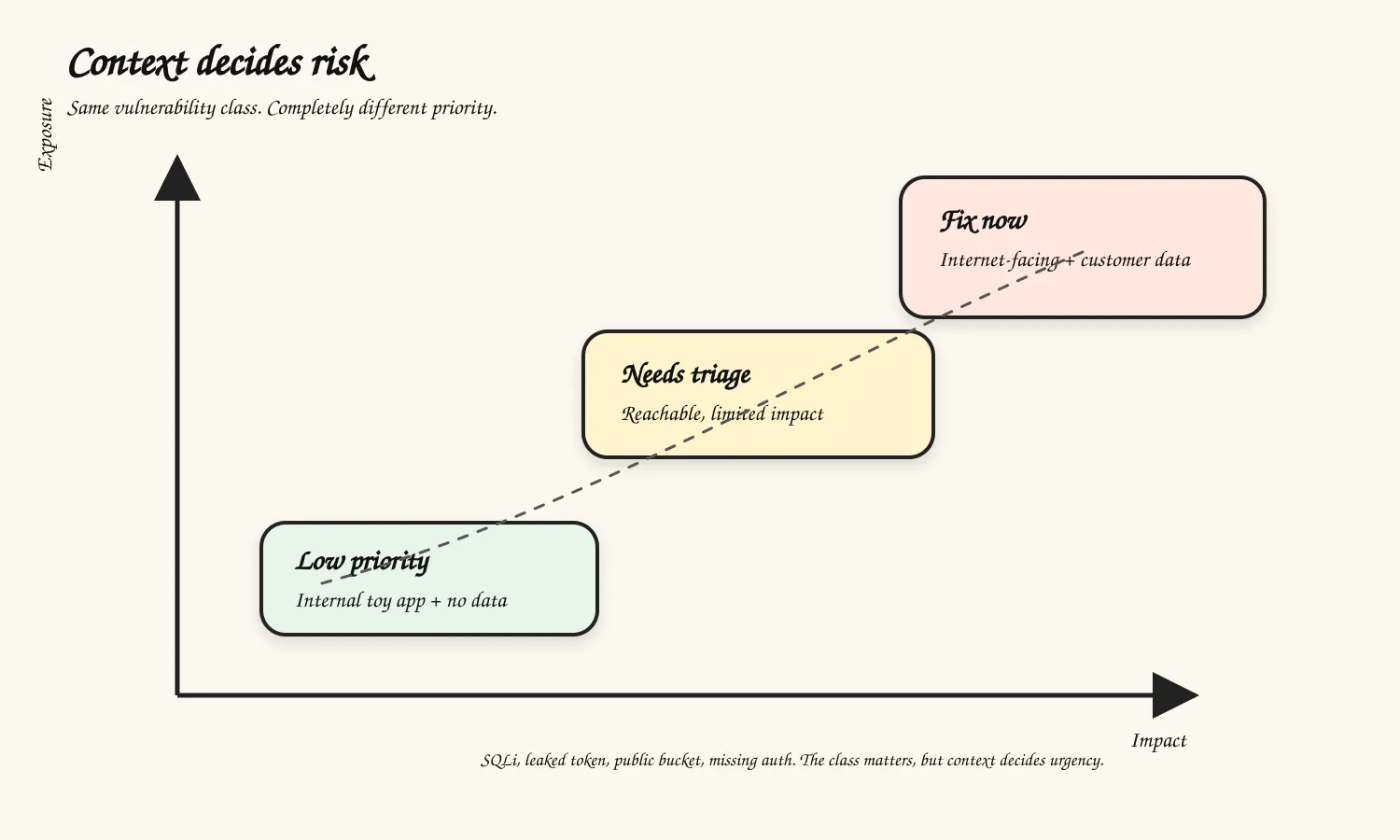
Context decides priority
The same issue can be critical in one place and noise in another.
A public S3 bucket with marketing images is not the same as a public S3 bucket with customer documents.
A leaked read-only test token is not the same as a production admin token.
A missing authorization check in an admin-only internal tool is not the same as one in a customer-facing billing flow.
A noisy SOC alert from a known batch job is not the same as the same behavior from a new host at midnight.
The vulnerability class matters. Context decides priority.
A good security engineer asks bigger questions:
- What business process or customer trust does this put at risk?
- How exposed are we, and how likely is this to be abused?
- Is this a one-off issue or a symptom of a broader system gap?
- Who owns the risk, not just the ticket?
- What level of risk are we willing to accept, and for how long?
- What is the smallest useful mitigation now?
- What control would prevent this class of issue from coming back?
- Does the fix scale across teams, products, and future systems?
That shift, from fixing a finding to managing a class of risk, is where security starts becoming engineering leadership.
Security work is people work
Most security bugs are technical. Most security fixes are social.
You talk to developers, product managers, platform teams, SOC analysts, infrastructure owners, support, legal, compliance, leadership, customers, and sometimes external researchers.
You need to know why something exists, what constraints shaped it, what tradeoffs are acceptable, and who can actually change it.
Sometimes your job is simply to ask the skipped question:
What happens if this token leaks?
Who can approve this action?
What data does this background job touch?
Why does this service need admin access?
What happens if this internal tool becomes public?
That is the difference between security as criticism and security as engineering.
This is insecure, fix it.
is easy.
Here is the risk.
Here is why it matters.
Here is the smallest safe fix.
Here is the longer-term pattern we should move toward.
is useful.
You find a microservice running with admin-level IAM. The criticism version files a ticket: “over-privileged role, fix it.” It sits untouched for months because nobody wants to break prod.
The engineering version asks the team why - and learns the admin role was a temporary shortcut during a 2023 migration that everyone forgot to revert. Now the fix is obvious, safe, and nobody is scared to ship it. The bug was technical. The fix was a five-minute conversation.
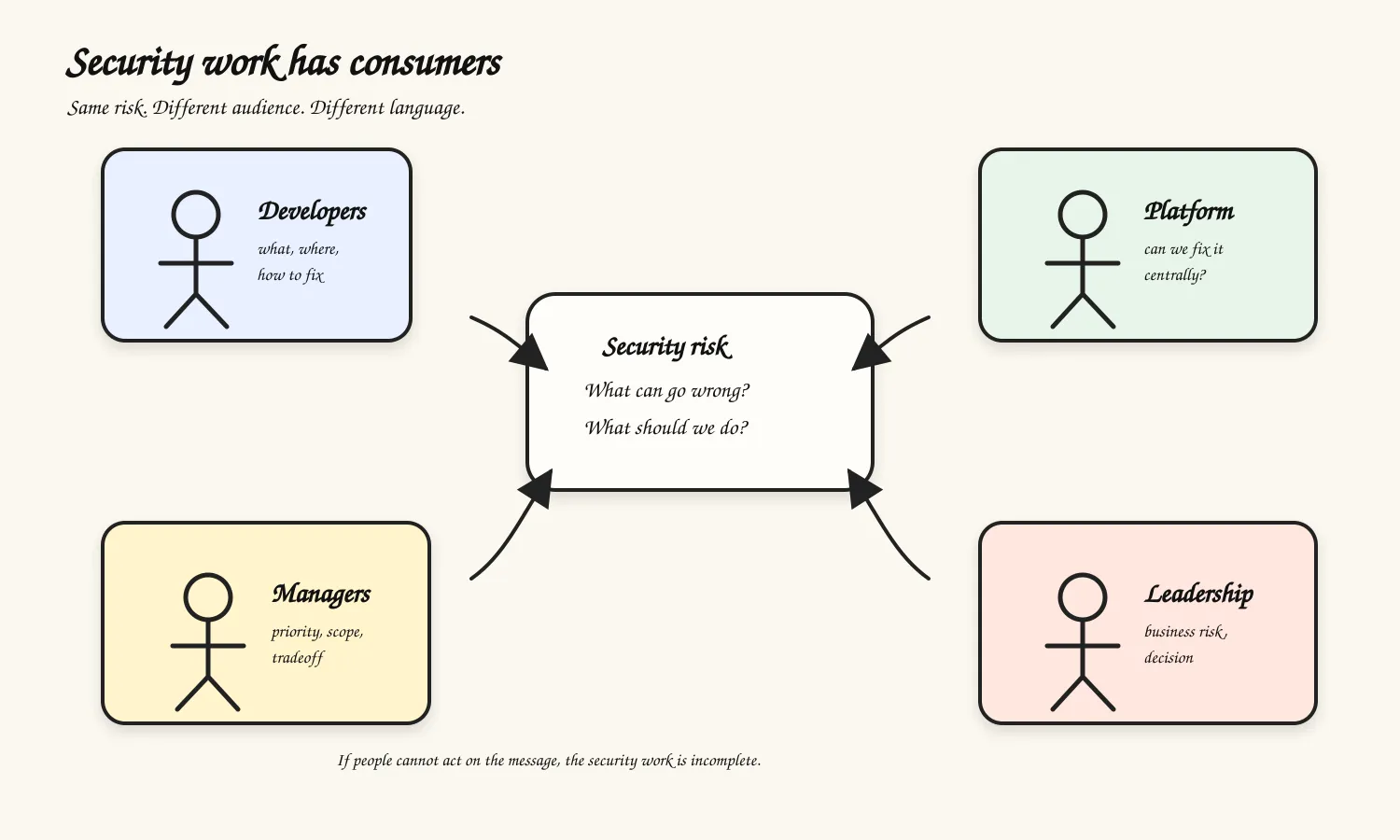
Security work has consumers
Security work has consumers. If you explain everything the same way to everyone, you are not being clear. You are just being uniform.
A product engineer debugging an auth bug, a platform team designing IAM defaults, a SOC analyst tuning detections, and a CISO explaining exposure to leadership are not asking for the same artifact.
Developers
- What is wrong?
- Where is it?
- How do I reproduce it?
- What is the expected fix?
- Is there a safe pattern I can copy?
- Will this block my release?
Give developers something actionable, not a lecture.
This endpoint accepts user-controlled input and passes it into this query. Here is the file. Here is a test case. Use this helper because it already handles escaping and auth checks.
Engineering managers
- Who owns this?
- How much work is it?
- Is it urgent?
- Can it wait?
- What happens if we do not fix it now?
- Is this a repeated pattern?
Managers need priority, scope, and tradeoff.
This affects checkout, it is internet-facing, and exploitation could expose order metadata. The immediate fix is small. The same pattern exists in three services, so fix this now and create a platform follow-up.
Platform and infrastructure teams
- Is this a one-off bug or a systemic gap?
- Can this be fixed centrally?
- Can we make the safe path the default?
- How do we roll it out safely?
Platform and infrastructure teams turn repeated findings into paved roads.
We keep seeing public buckets created manually. Instead of filing tickets one by one, make the Terraform module private by default, add an exception path, and alert only on buckets outside the module.
SOC and detection teams
- Is this alert actionable?
- Is this malicious behavior or expected noise?
- What signal would make this higher confidence?
- What context is missing from the alert?
- Can we detect this earlier in the attack chain?
SOC teams need signal, context, and response paths.
This alert fires on every deploy. Add service ownership and deployment context, suppress known release windows, and page only when the behavior comes from an unmanaged host or a privileged identity.
Leadership
- What is the business risk?
- Are customers affected?
- Are we exposed right now?
- What decision is needed?
- What is the cost of fixing versus accepting?
Leadership needs decision support, not implementation detail.
We have a production exposure that could allow unauthorized access to customer documents. We have not seen evidence of abuse. The fix is in progress. Longer term, we need ownership mapping and automated access reviews because this came from a recurring gap.
The point: security engineers do not just produce findings. They produce understanding.
Risk comes before tools
A mature security engineer does not start with the tool. They start with the risk.
The question is not, “Did the scanner find something?”
The question is, “Does this meaningfully change the organization’s exposure, and what should we do about it?”
This is where tools can help, but only if they improve judgment.
A scanner, dashboard, pipeline, or detection rule is useful when it helps the team decide what matters, who should act, and how to prevent the same exposure from coming back.
Tools should answer:
- Is this issue real?
- Is it reachable?
- Is it exploitable here?
- Who owns it?
- What is the fix?
- What is the priority?
- Can we prevent this class of issue?
Security engineering is not:
we built a tool
It is:
we reduced the risk, and the system is now harder to misuse or break
The best security engineers can still go deep into the weeds. They know how the systems are built because they have built them, broken them, reviewed them, and cleaned them up. But they do not mistake the weeds for the goal.
The goal is risk reduction.
A team buys a shiny CSPM that surfaces 4,000 “misconfigurations” on day one. Nobody triages them, so the dashboard quietly becomes wallpaper.
Starting from the risk instead - “which of these buckets actually hold customer data and are reachable from the internet?” - turns 4,000 findings into one prioritized, owned list of twelve that people actually fix. The tool was identical. The judgment was not.
Build systems that reduce whole classes of risk
Once you understand the risk, the senior move is to prevent the same class of risk from coming back.
That applies across the stack: product security patterns, infrastructure defaults, DevSecOps checks, SOC detections, and incident response playbooks.
Bad security shows up at the end, when the feature is already built and the release is already close.
Proactive security moves earlier.
It builds the road instead of standing at the toll booth.
That means paved roads like:
- Product security: reusable authz patterns, safe defaults for sensitive flows, abuse-case reviews.
- Infrastructure security: least-privilege IAM, private-by-default storage, hardened network paths.
- DevSecOps: secret scanning, dependency checks, container scanning, policy checks before deploy.
- Platform engineering: safe Terraform modules, service ownership, golden paths for common patterns.
- SOC and detection: high-signal alerts, useful context, response playbooks, logging that answers real questions.
- Incident response: clear escalation paths, decision owners, and post-incident fixes that remove repeat failure modes.
A team keeps shipping IDOR bugs - every few months, another endpoint trusts a user-supplied account_id and leaks someone else’s data. Filing each one is whack-a-mole.
The class-level fix is a single authorization helper every handler must call, plus a lint rule that fails CI on any data access that skips it. One change, and that entire bug class stops reaching production - instead of being rediscovered forever.
This is where DevSecOps matters. Not as a buzzword. As a principle:
Security should be built into the way software is designed, shipped, and operated.
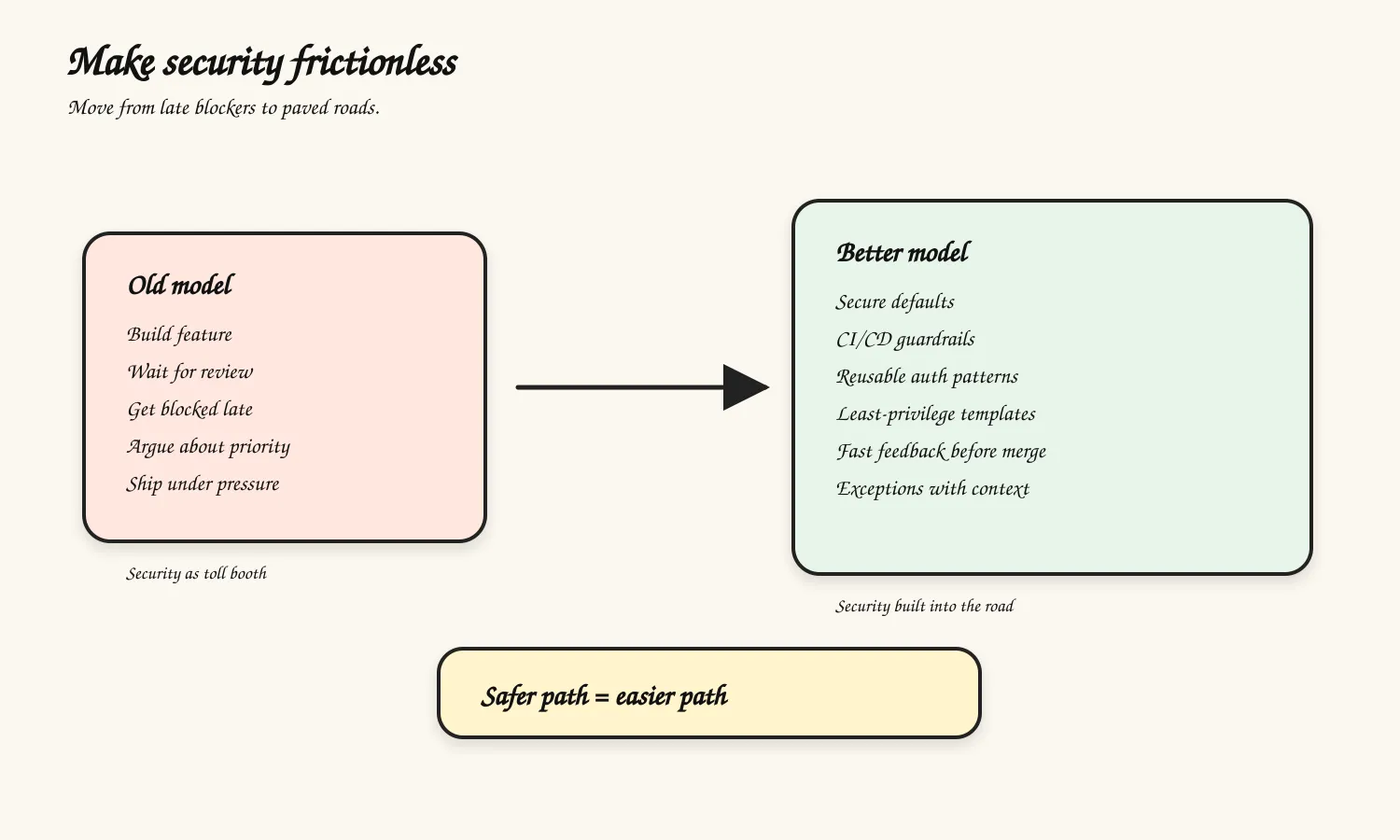
If every security decision requires a meeting, you will lose.
If every safe path requires custom effort, people will route around it.
If the insecure path is faster, the insecure path will win.
Engineers take the path of least resistance
In physics, a body always settles into the path of least resistance. Water finds the crack. Current finds the conductor. A ball rolls down the gentlest slope, not the one you wish it would take.
Engineers under a deadline are no different. Whatever path has the least friction is the path they will take, every single time. So the only durable security strategy is to make the secure path be the path of least resistance. If the insecure path is faster, physics is not on your side.
Take S3 buckets. If creating one means hand-writing a bucket policy, a good share of them will end up public by accident - that hand-rolled path is where the friction, and the mistakes, live.
So you ship a Terraform module that is private, encrypted, and logged by default. Now the easy path is the safe path. Making a bucket public is still possible, but it takes a deliberate, reviewed override flag - so anyone who does it actually knows what they are doing, instead of leaking customer data through a copy-pasted snippet.
Security teams create friction when they give vague comments, noisy tools, slow reviews, policies without examples, or “no” without a safer “yes.”
Friction does not make a company secure. It makes people avoid security until the last possible moment.
The best security control is the one developers barely notice because the secure thing is already the easiest thing.
- Fast feedback instead of late surprises
- Clear fixes instead of vague warnings
- Paved roads instead of tribal knowledge
- Automated guardrails instead of manual approvals
- Reusable patterns instead of one-off reviews
- Context-aware prioritization instead of ticket floods
Security should help the organization move faster without accidentally setting itself on fire.
The maturity ladder is about leverage
This is the simplest way I think about security maturity. As the work gets better, it moves from individual judgment to repeatable leverage.
Don't do this.
Here is the risk.
Here is the safer way.
I made the safer way the default.
That is the jump from review culture to engineering culture. The goal is not to personally catch every mistake forever. The goal is to design systems where the common path is already the safer one.
Take secrets in code. Bad: “stop committing secrets” in a PR comment. Better: “here is why a leaked key is dangerous.” Good: “use the secrets manager, here is the snippet.” Great: a pre-commit hook plus a CI scan that blocks the push, so the secret never lands in history in the first place.
Same problem. Four very different amounts of leverage.
In the end, it is still about risk
Security engineering is not about eliminating all risk. That is impossible.
The job is to make risk visible, understandable, and smaller.
Sometimes that means fixing a vulnerability. Sometimes it means accepting a low-risk issue because something else matters more. Sometimes it means building a guardrail. Sometimes it means telling leadership, clearly, “This is the risk we are carrying.”
So, security engineer kaun?
The person who helps the organization understand what can go wrong, fix what matters, and build systems where the safer path is easier to follow.
Less dramatic than the movie version. Much more useful.
If you work in security, engineering management, development, or platform engineering, I would love to hear how this maps to your experience.
What did I miss? What would you phrase differently? Where do you think security engineering actually creates leverage inside an organization?
Thank You!
Comments